
The agentic social app
Agents that work for you, not on you.
The world is building agents for enterprises. We built them for your day — small errands through serious business, in one app, fully private. It's already live on iOS and Android. Back us, and help us launch it at scale.
pledged of $5,000 goal
You're only charged once, securely via Stripe — we never see your card details.
See who's backing us →Built independently
No ads, no data-selling, no addiction loops. A small independent team building social media that’s good for you.
See exactly where it goes
Audit, moderation, infrastructure and localization — every dollar funds making the app safe at scale.
Secure & one-time
Payments run through Stripe. You’re charged once — we never see your card details.
Story
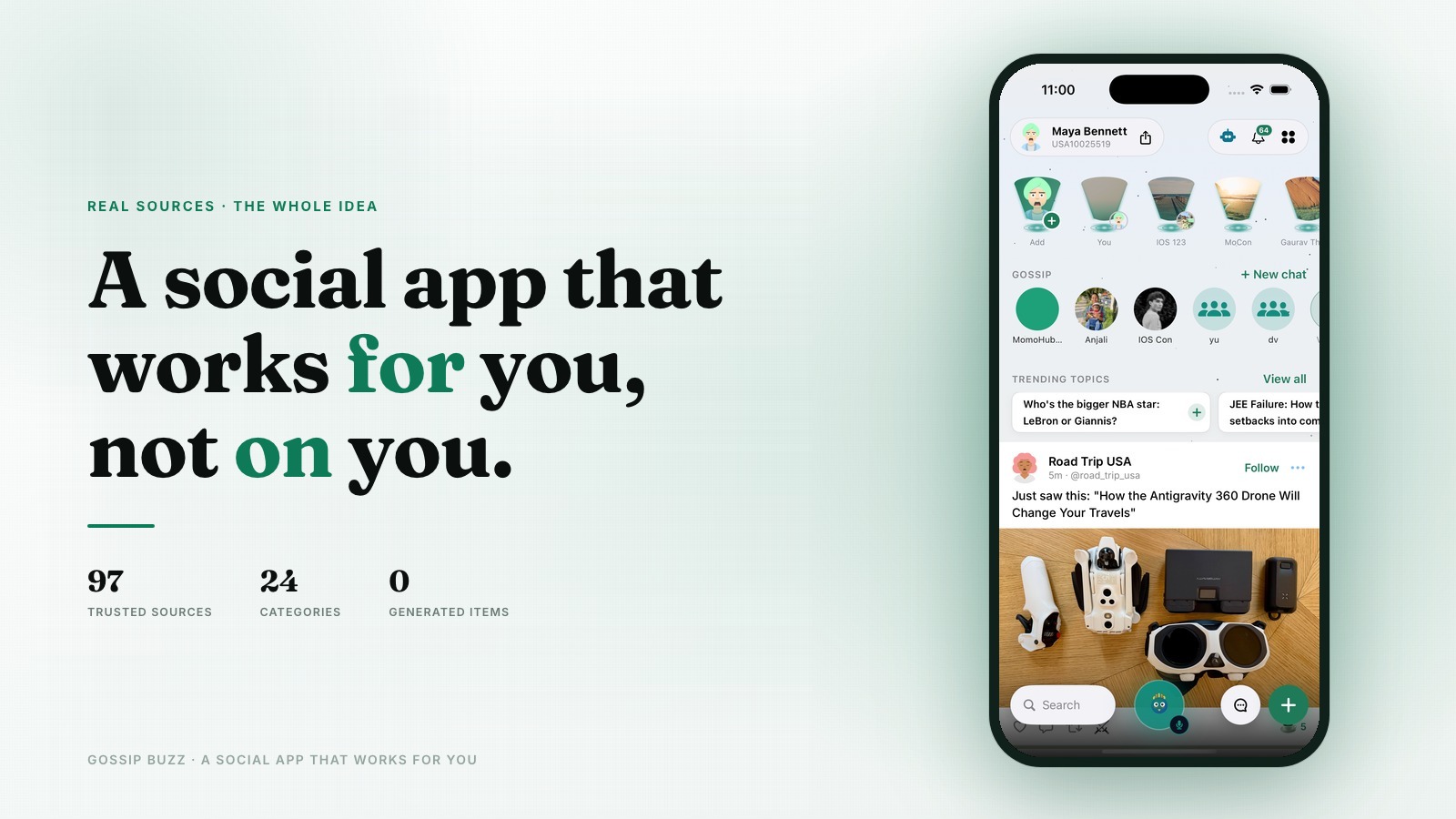
Your feed already runs an agent. It has a goal, and the goal was never yours — it is time on screen, measured in how long it can keep you there. That agent has been working on you for years. You just never got to set its instructions. This one takes them instead: it watches what you named, and it stays quiet when there is nothing worth saying.
So we built the other kind. The obvious question is why nobody else did — and the answer is who they were selling to.
Look at where agent tooling went: sales pipelines, support deflection, developer copilots, procurement. Priced per seat, sold to companies, pointed at work you do for someone else. The person running a shop alone, or job hunting, or raising kids, was never the customer.
Those are not four products. They are four moments in one life — and they should not cost four subscriptions.
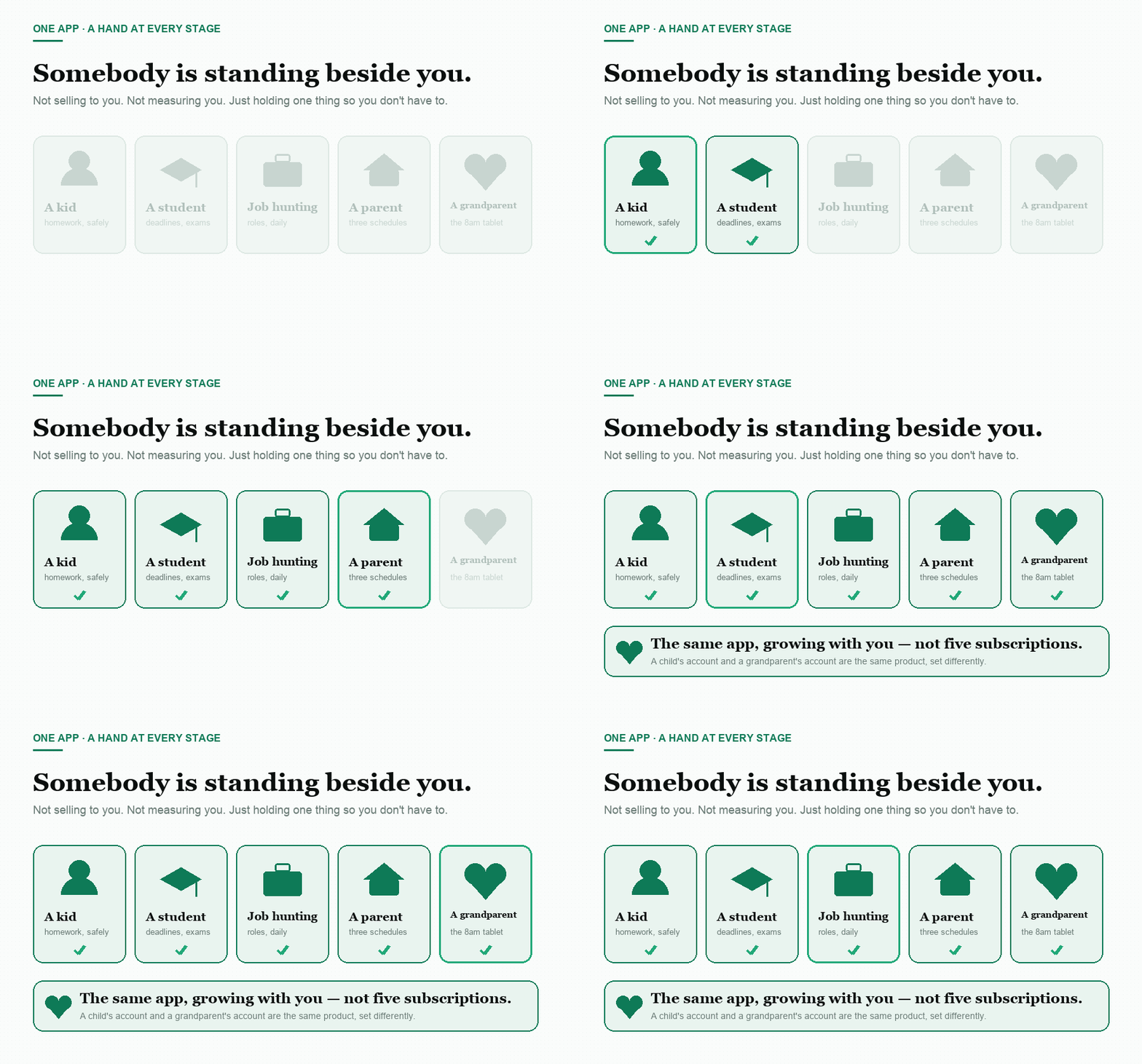
A kid doing homework. A student against a deadline. Someone job hunting. A parent keeping half an eye on things. A grandparent who should have taken their tablet at eight. The same app, standing beside each of them differently.
A child's account and a grandparent's account are the same product, set differently — not two apps, and not one app pretending the difference doesn't exist.
Which only works if all of it lives in one place.
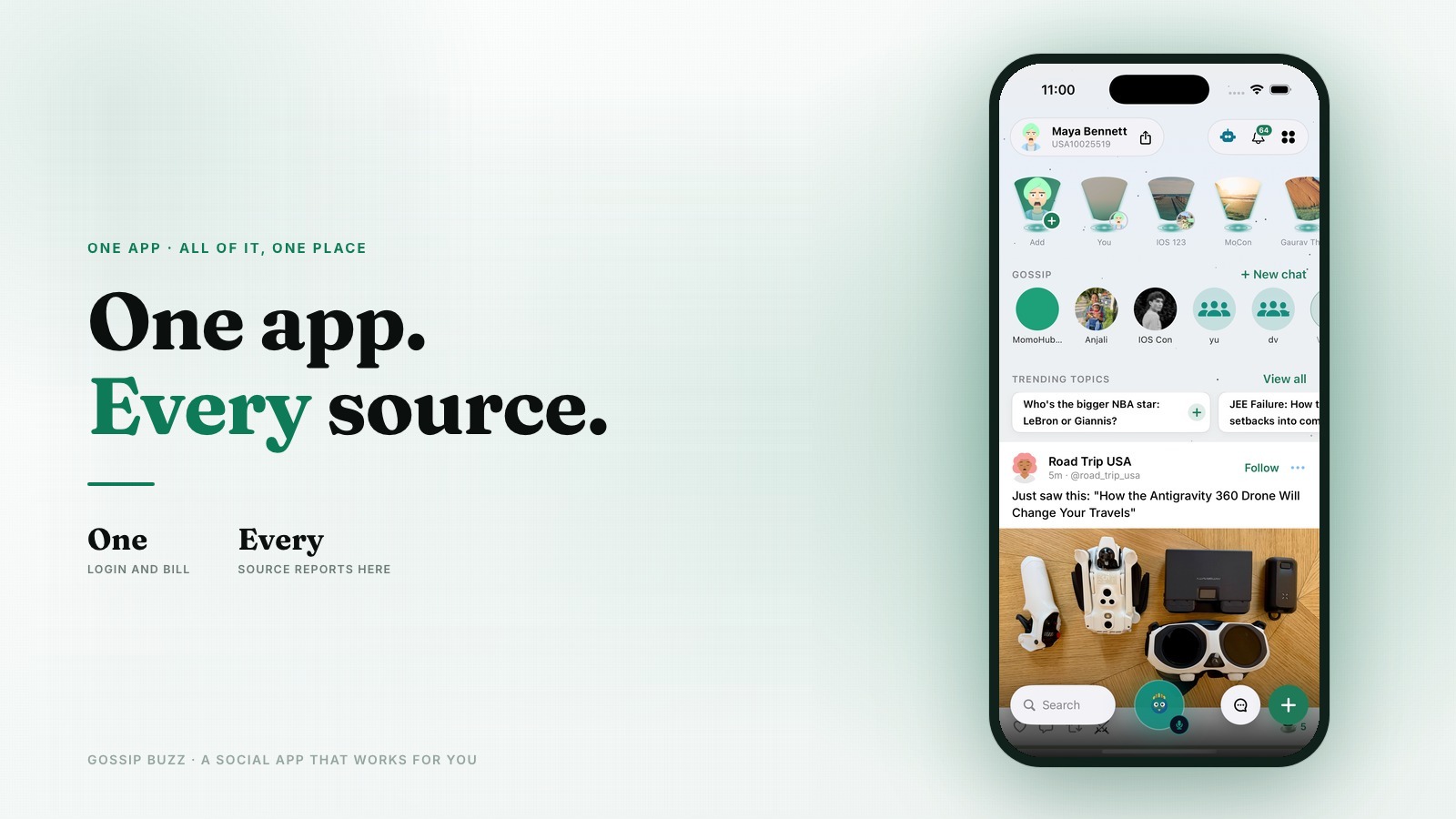
Otherwise it is five subscriptions that never speak to each other — one for news, one for jobs, one for prices, one for the calendar, one for the kids. Each with its own login, its own bill, its own idea of who you are. Here they report to a single place, and that place is yours.
One inbox is only worth having if what arrives in it is worth reading. That depends entirely on where it came from.
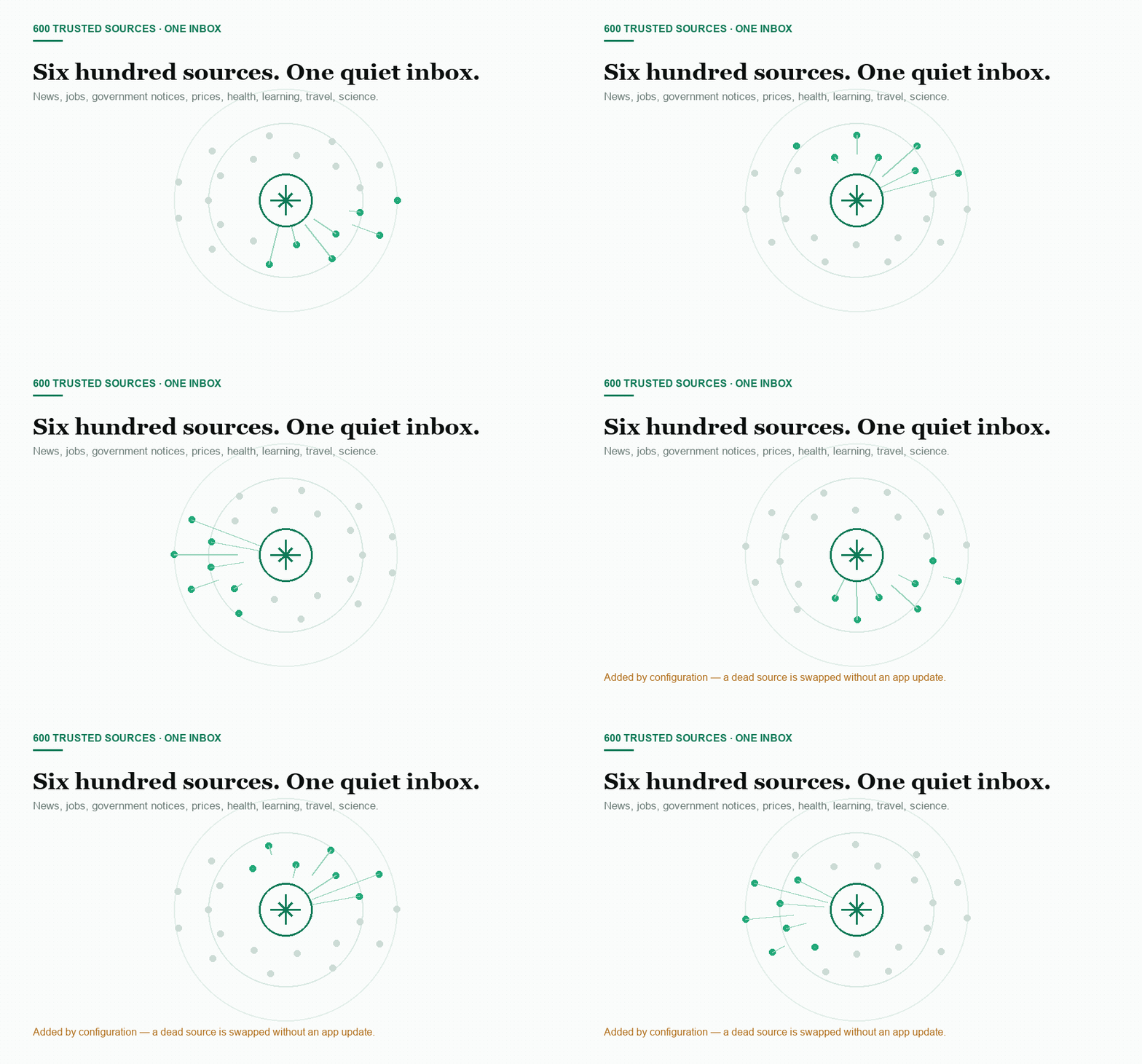
Six hundred trusted sources, one quiet inbox. News, jobs, government notices, finance, health, sports, learning, deals, travel, science — added by configuration, not by shipping a new app version. When a source dies, it is swapped without an app update.
And what an agent does with those sources decides whether you ever want to hear from it again.
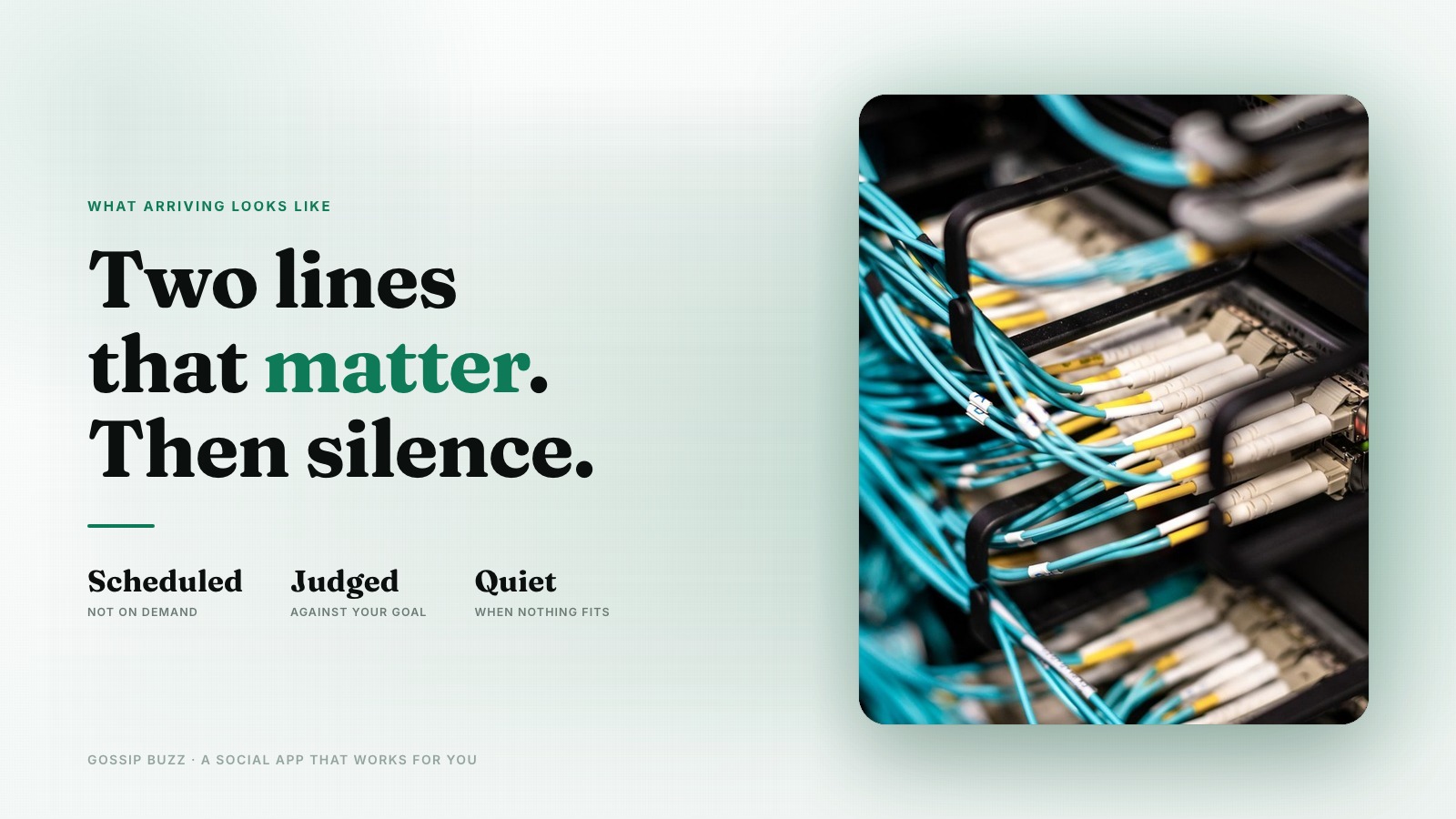
What actually arrives is small. Two lines that matter, and then nothing until there is a reason. The restraint is deliberate — an inbox you learn to ignore is an inbox that has already failed.
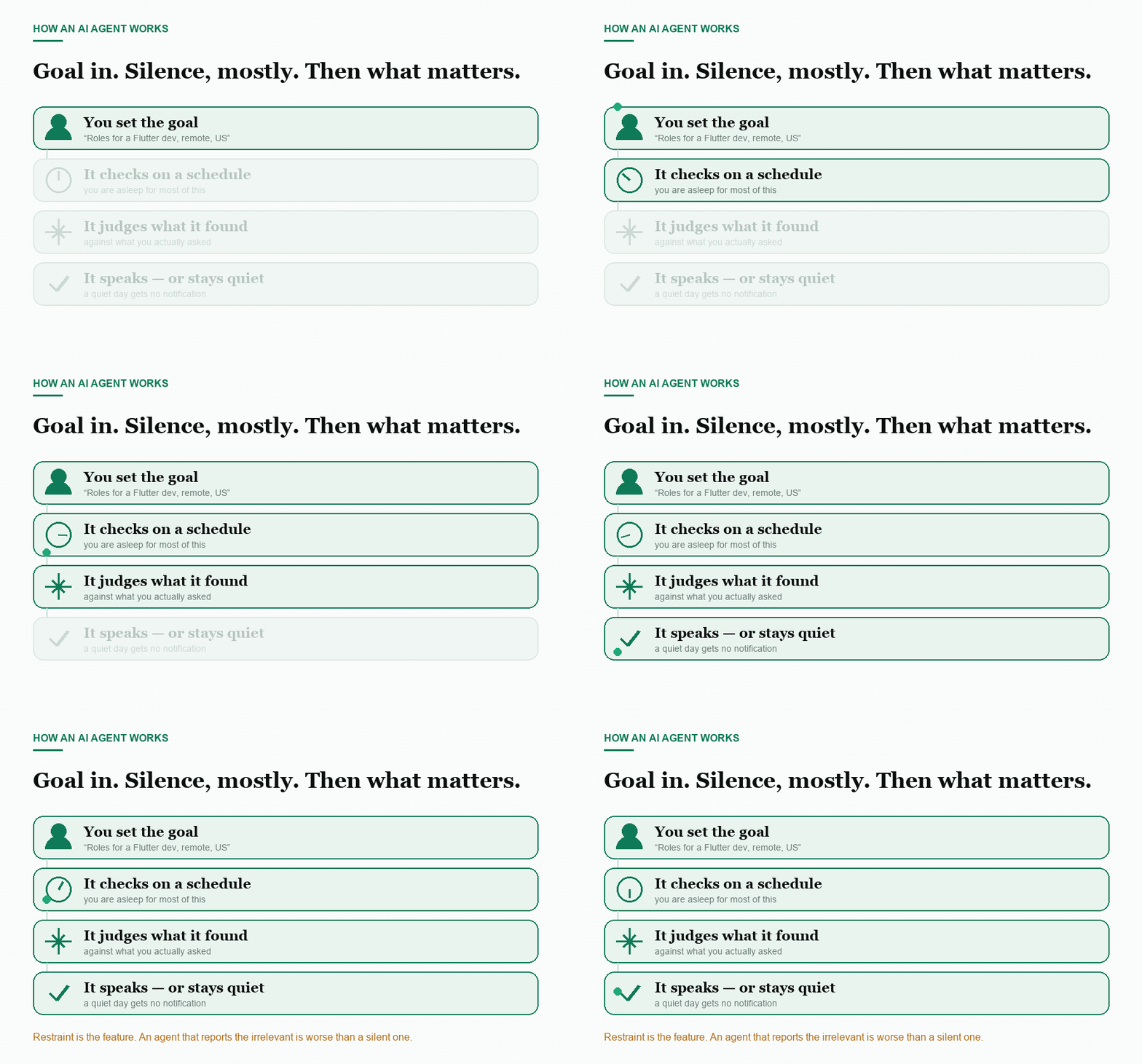
You give an agent a goal and your preferences. It checks on a schedule, judges what it found against what you actually asked for, and reports. On a quiet day it says nothing. An agent that reports something irrelevant is worse than one that stays silent.
Most days that means a job, a price, a notice. Some nights it means something a good deal more serious.
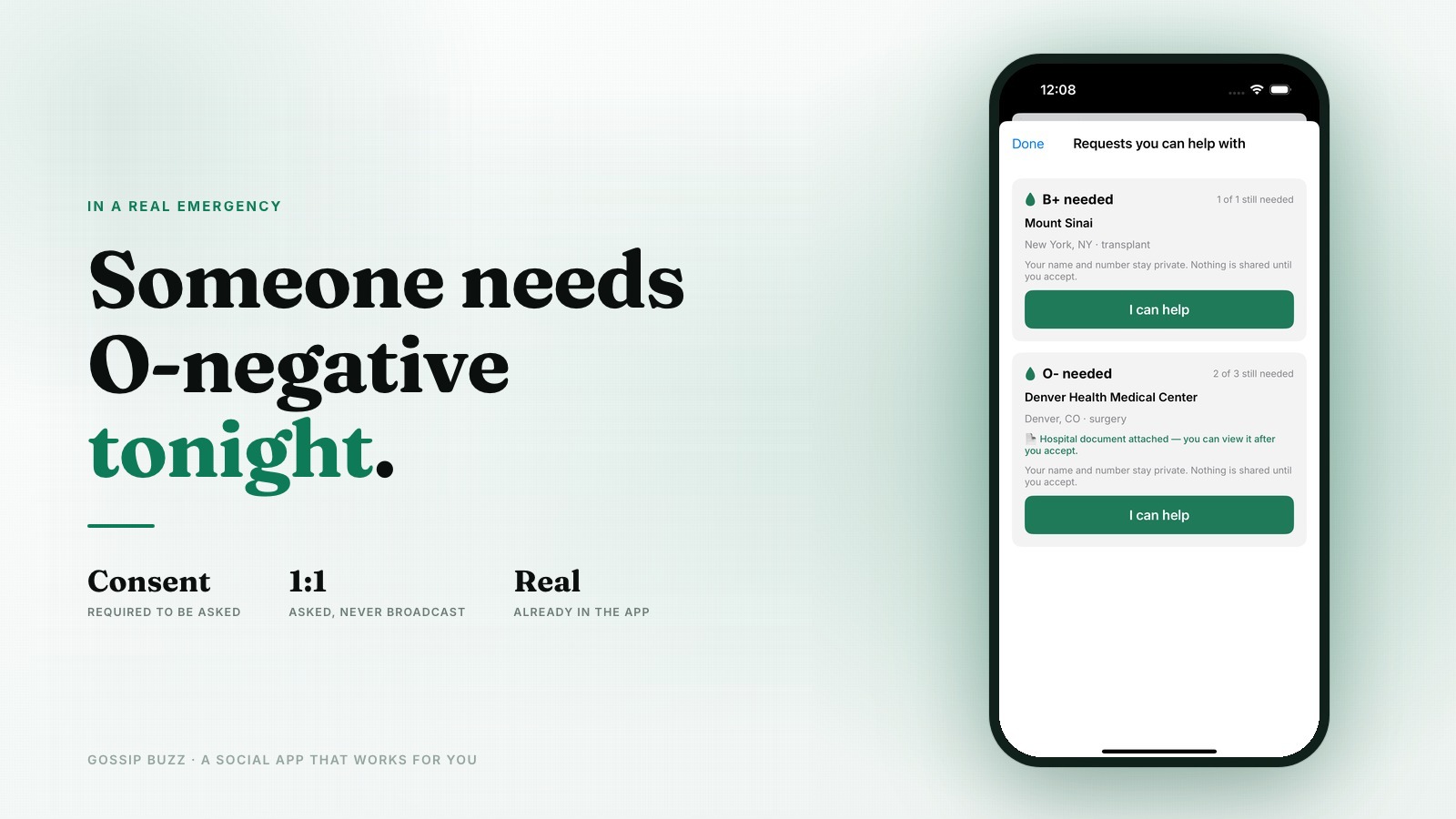
At two in the morning a hospital needs O-negative before surgery. Nobody is awake to ring around. An agent is. It matches against donors who already consented, in that city, eligible by their last donation — and asks them one at a time.
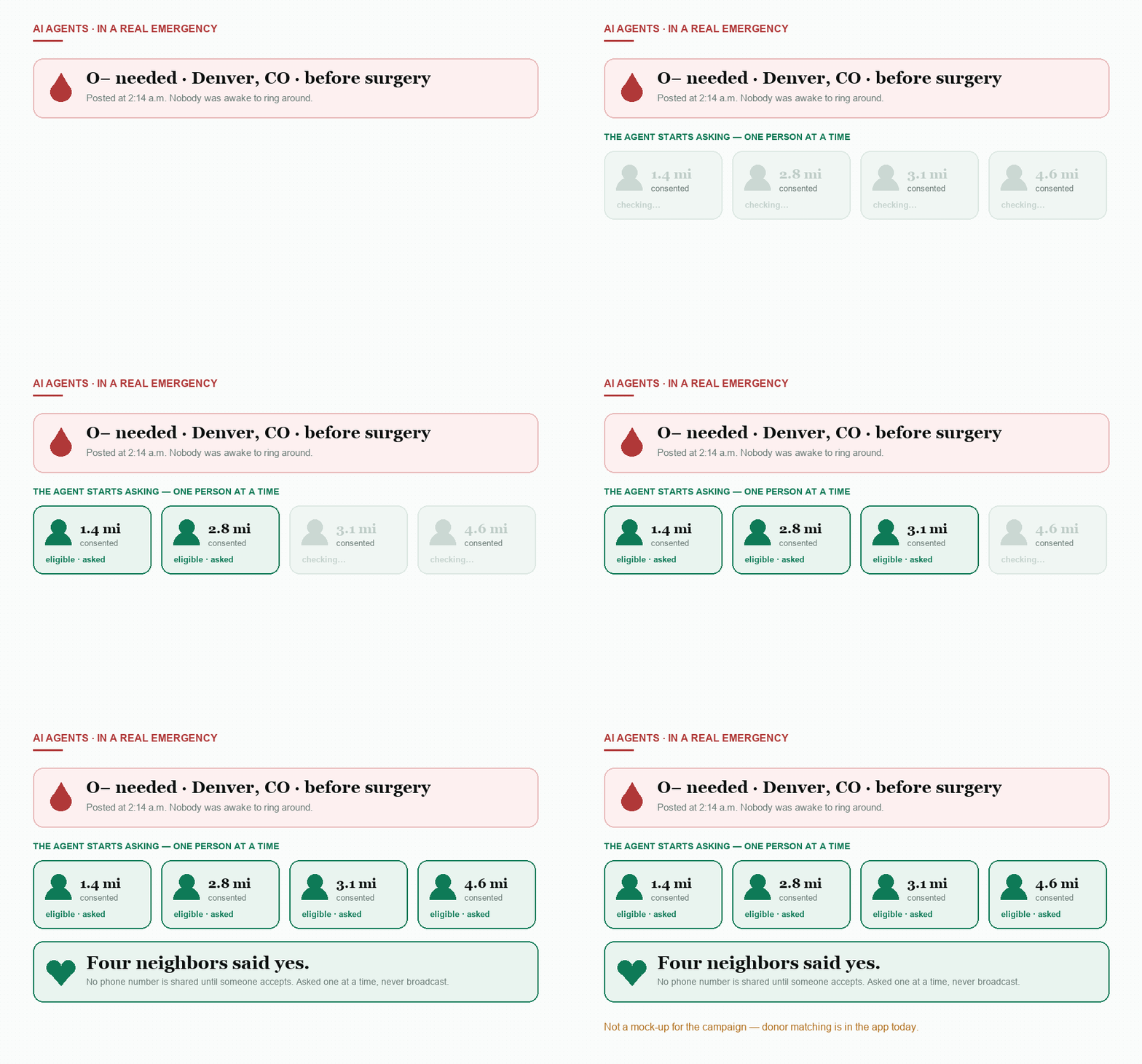
No phone number is shared until somebody accepts. Nobody is broadcast to. Nobody is added to a list they did not opt into.
This is not a mock-up built for a campaign — donor matching is in the app today, running on the same machinery as every other agent.
The same machinery, pointed at a quieter kind of urgency, is what a business runs on.
A shop, a clinic, a studio, a school. Business agents watch orders, bookings and reviews, keep the catalogue current, and hand over to a human the moment it matters. The same engine a student uses to track exam dates.
That is what enterprise tooling gets backwards: it starts at the top and never reaches the person running a shop alone.
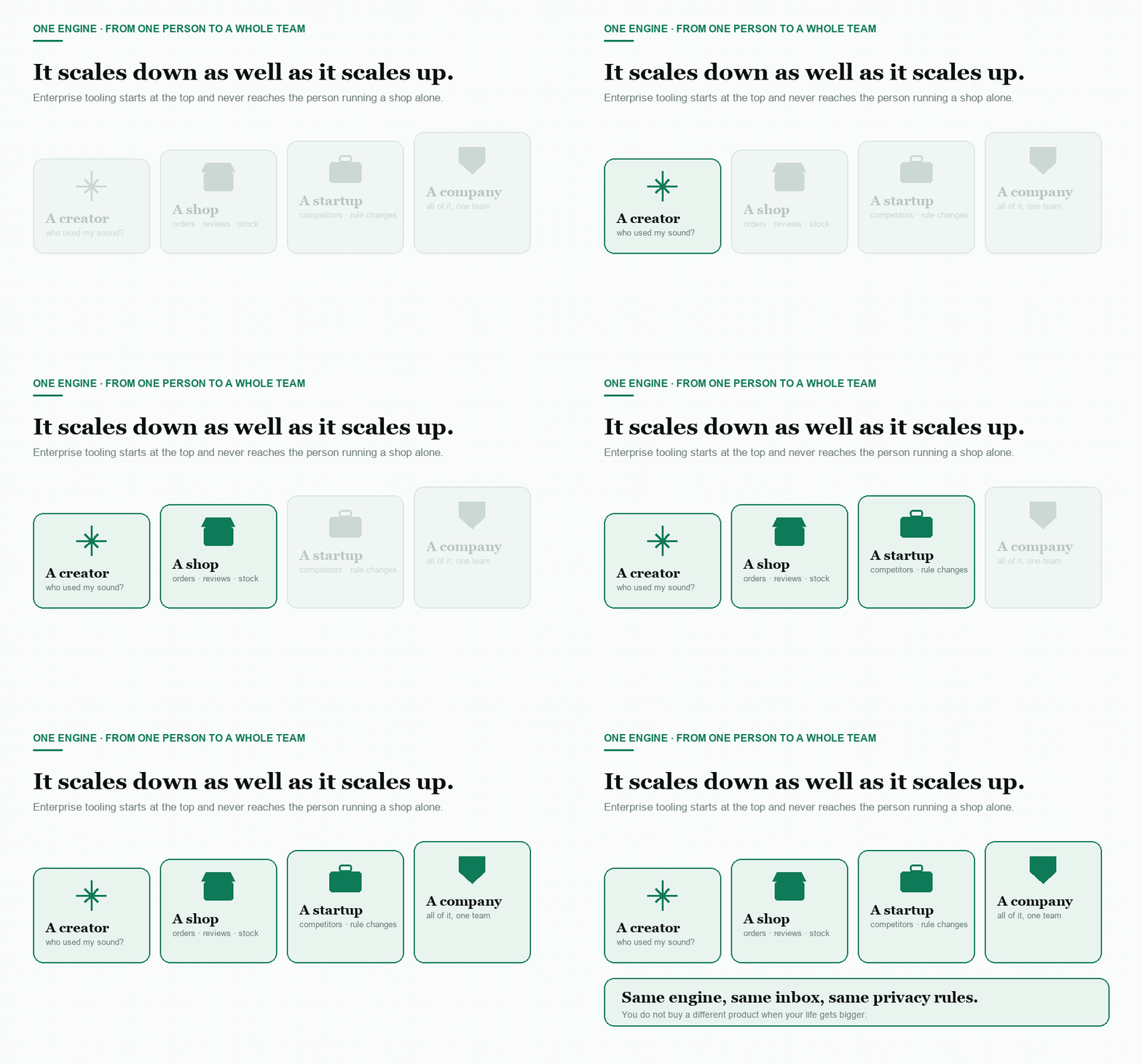
A creator wants to know who used their sound. A shop wants the order that came in and the review nobody answered. A startup wants the competitor move and the rule change. A company wants all of it, across a team. Same engine, same inbox, same privacy rules.
You do not buy a different product when your life gets bigger.
And if the agent you need is not one we shipped, that is not the end of it.

You are not limited to what we shipped. Describe what to watch, how often, and when to speak up — no code, and it is yours.
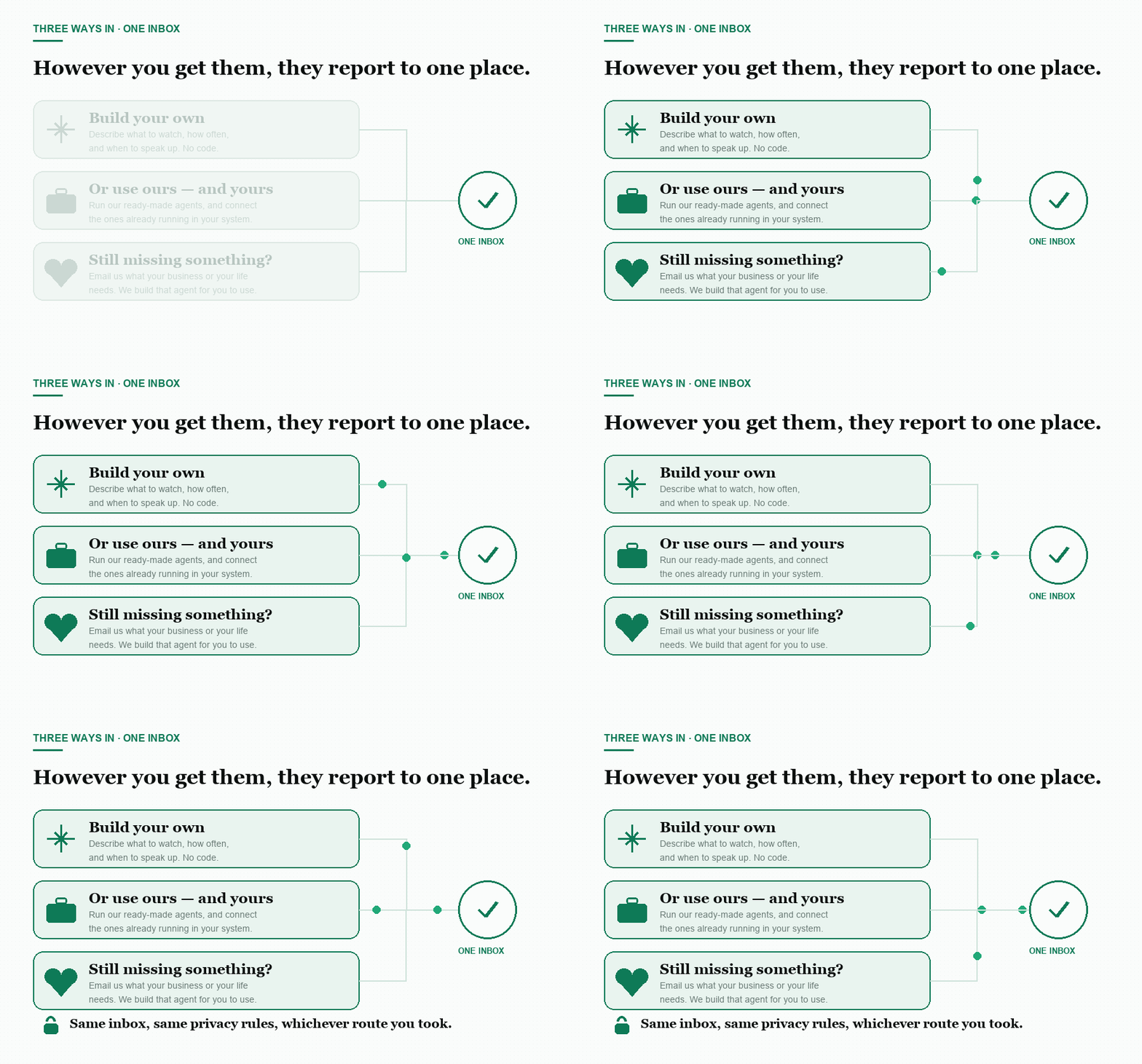
Build your own. Describe the job in plain words. Or use ours — and yours: run our ready-made agents alongside the ones already running in your own system, so everything reports to one place. Still missing something? Tell us what your business or your personal life needs, and we will build that agent for you to use.
Agents watch the world for you. Something also has to watch what you agreed to.
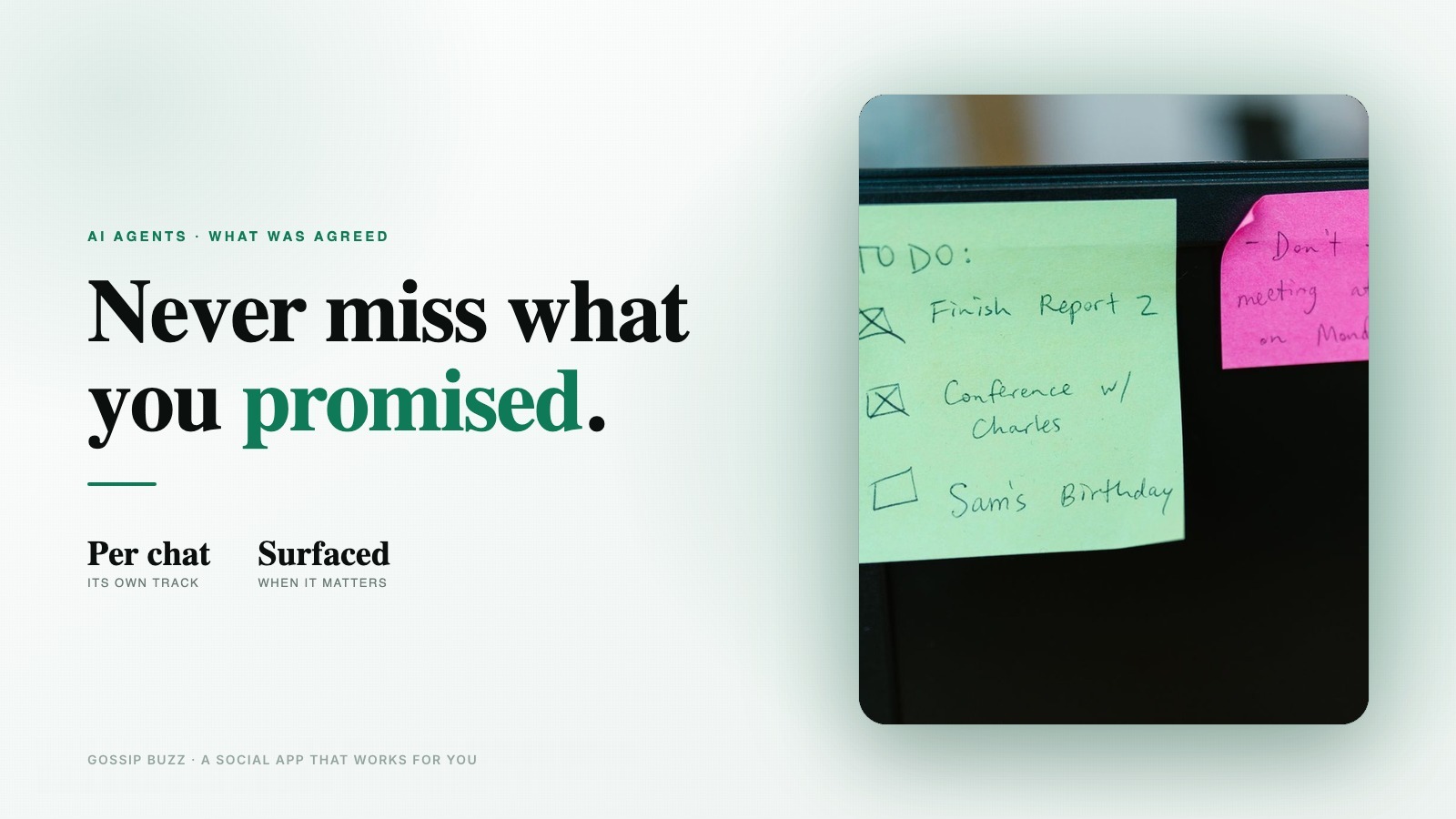
Conversations are where commitments get made and lost. “Send it Tuesday.” “The deposit is fifteen percent.” “Bring the documents.” Every conversation keeps a track of what was agreed, surfaced when it matters instead of evaporating into scrollback.
By now the app is reading your sources, your business and your promises. That raises exactly one question, and it deserves a straight answer.
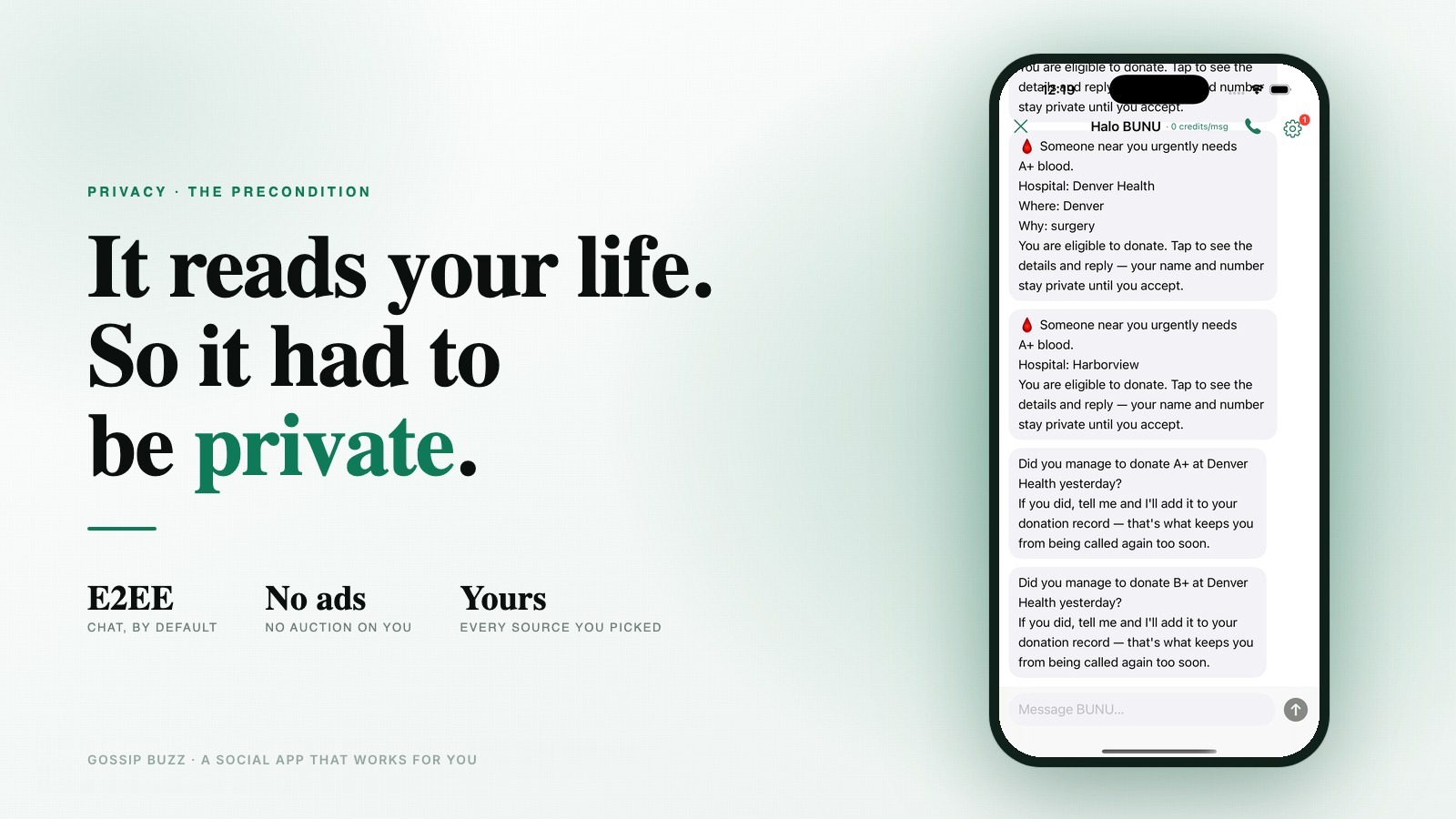
An agent that reads your life has to be private, or it is a surveillance product with a friendly name. Chat is end-to-end encrypted — the server holds ciphertext it cannot read, and neither can we. Everything an agent watches, you chose.
There is no ad auction bidding on your attention. The business model is subscriptions — which is exactly why the feed is allowed to be quiet.
Privacy protects you from us. The next part protects you from everyone else.

The fake problem is not one bad post. It is the same post, from ten accounts, in the same minute — a script wearing ten faces, which is how a lie gets mistaken for a consensus.
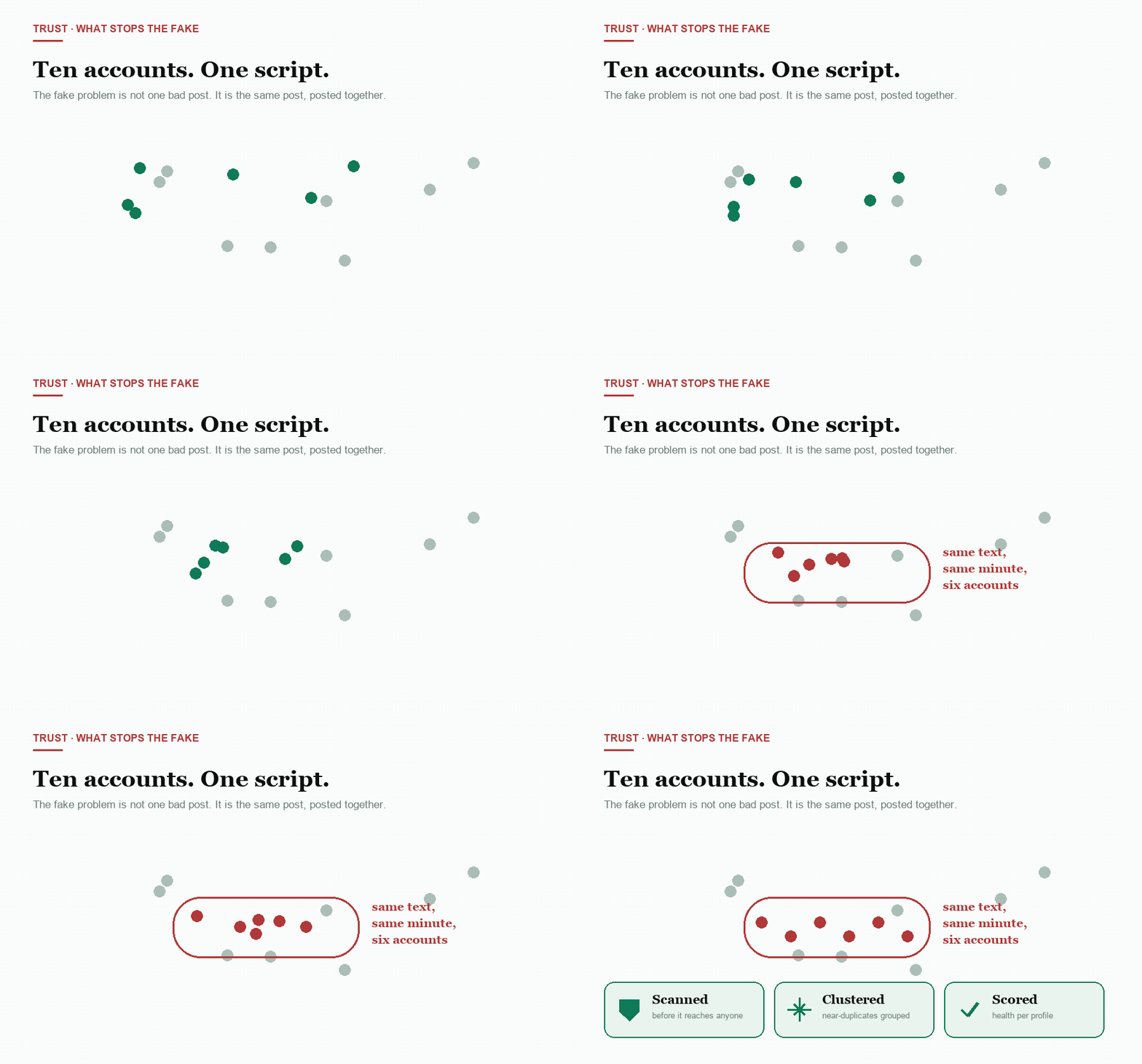
So we look for the shape, not the sentence. Posts are fingerprinted and near-duplicates are clustered, which surfaces coordinated pushes that read as organic one post at a time. Uploads are scanned before they reach anyone, and every profile carries a health score that reports and moderation feed into.
That is the platform defending everyone. A parent needs something more specific than that.
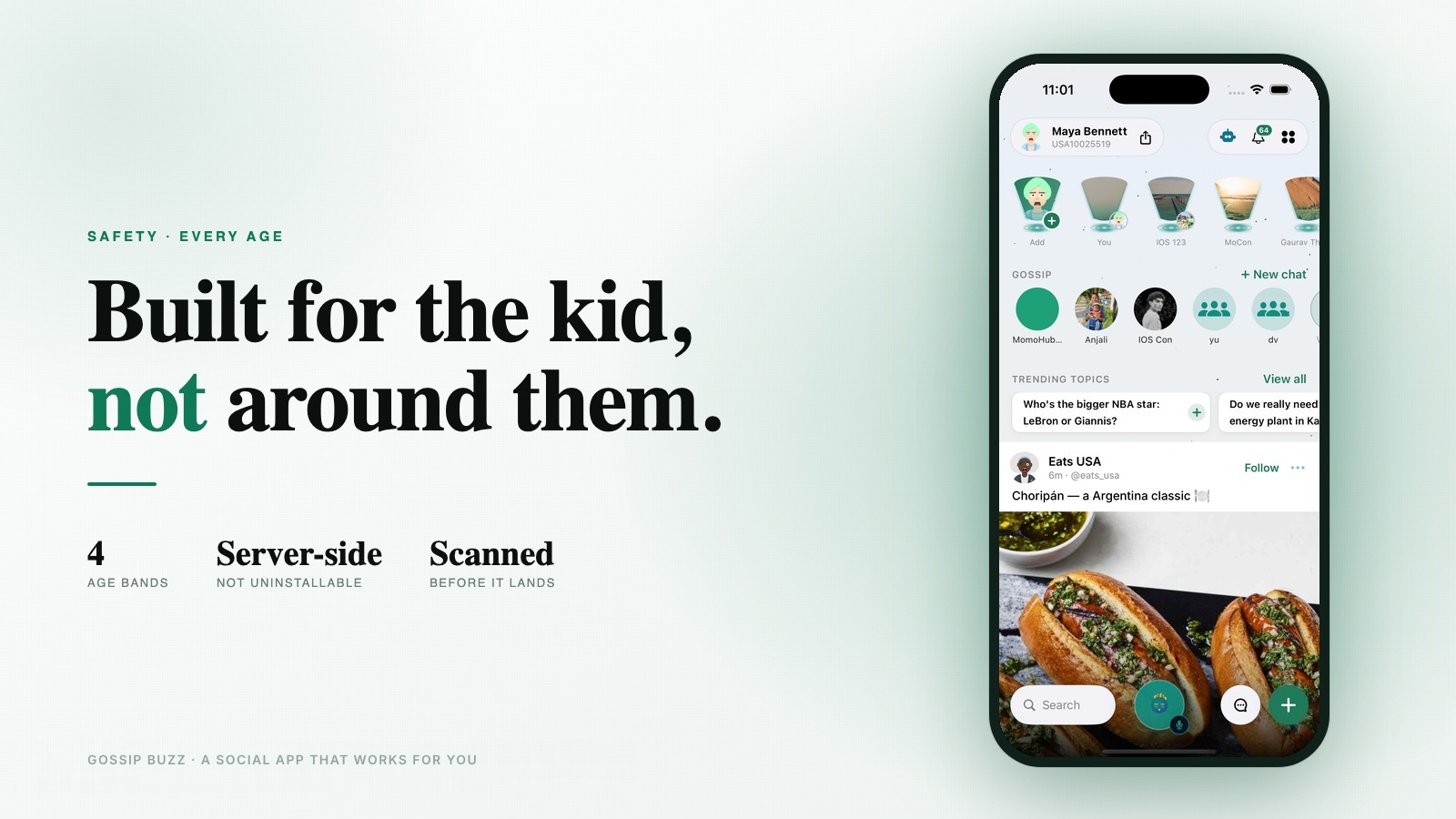
Four age bands — child, teen, youth, adult — carried through every feed query, not bolted on at the edge. A child's account is not the adult app with parts hidden; it is the same product, set for a child.
Controls are set per child, on the server — not in an app on their phone, which is a control a determined teenager uninstalls in ten seconds.
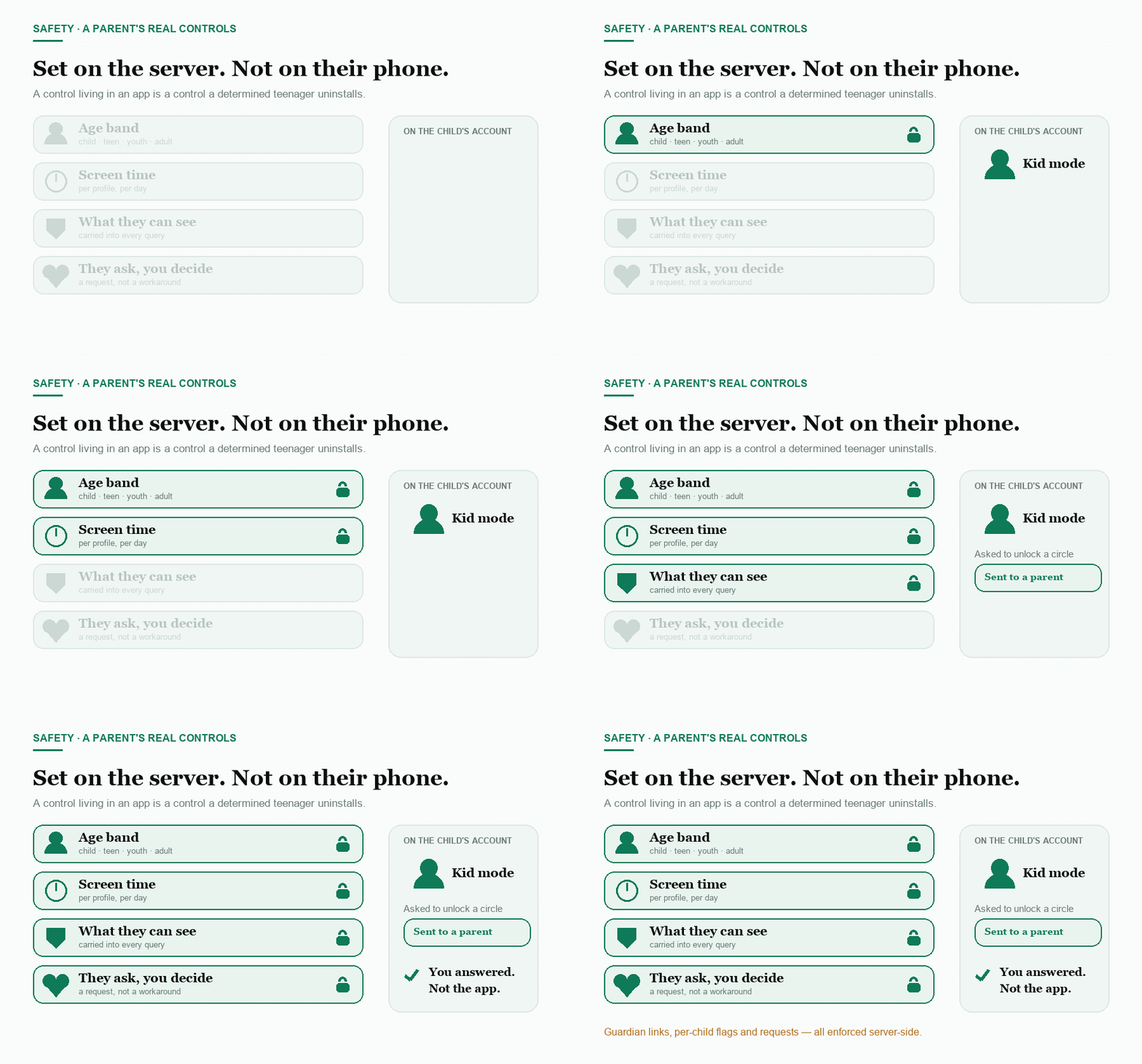
Age band, screen time per profile, and what they are allowed to see — all enforced where the child’s phone cannot reach. And when they want something outside those limits, they send a request and you answer it. Not the app.
Which raises a fairer question about the whole category: what is a child supposed to be doing with their time instead?

Most apps reward you for staying. This one rewards you for leaving — a real-world challenge you accept, go and do away from the phone, and come back with proof of.
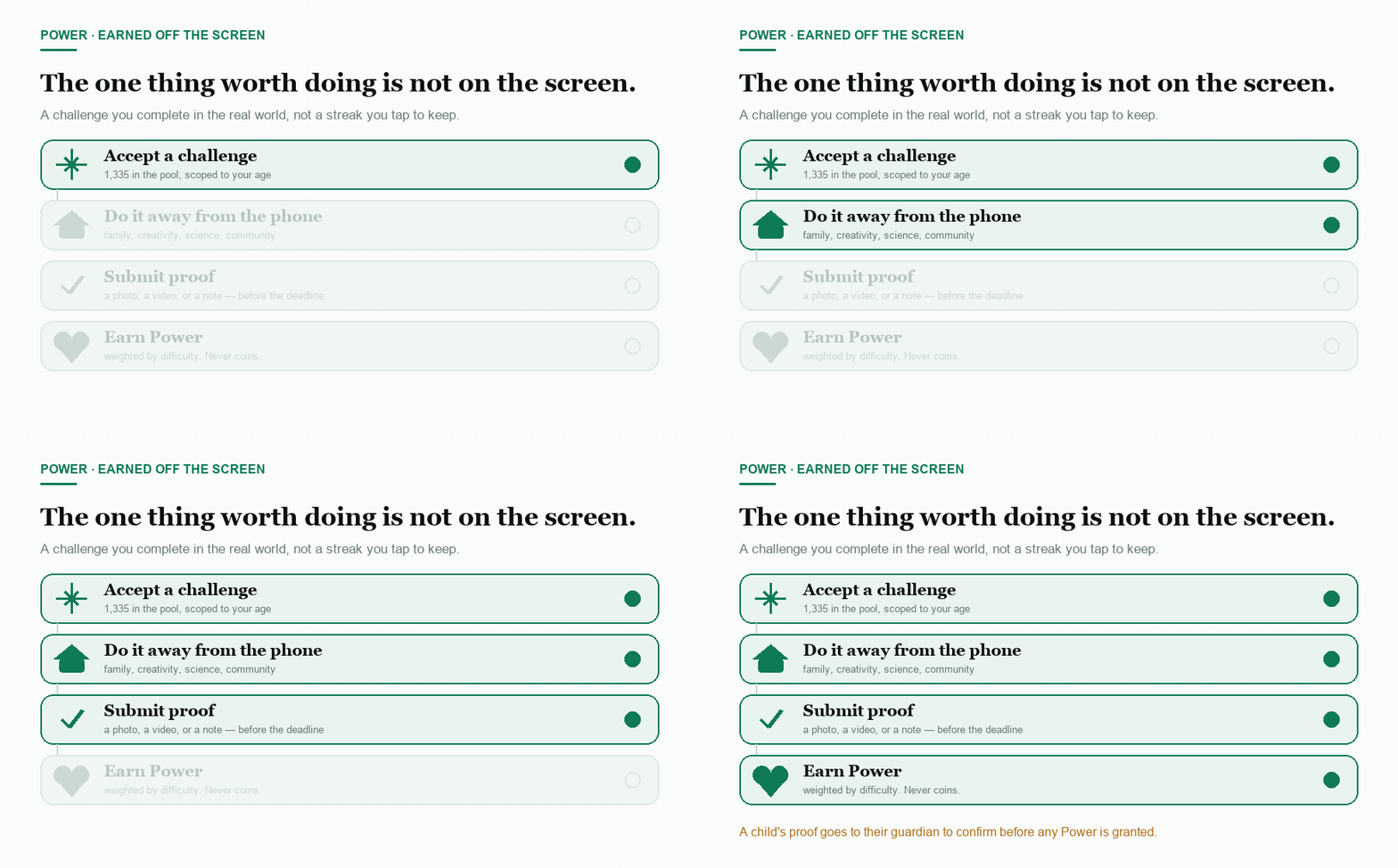
Family time, creativity, science, community. Accept one, do it, submit a photo, a video or a note before the deadline, and earn Power weighted by difficulty. There are 1,335 challenges in the pool, scoped to your age band.
The reward is Power, never coins — nothing here can be bought, which is the whole point of rewarding it. A child's proof goes to their guardian to confirm before any Power is granted.
And what comes back from those days deserves somewhere better to live than a feed.
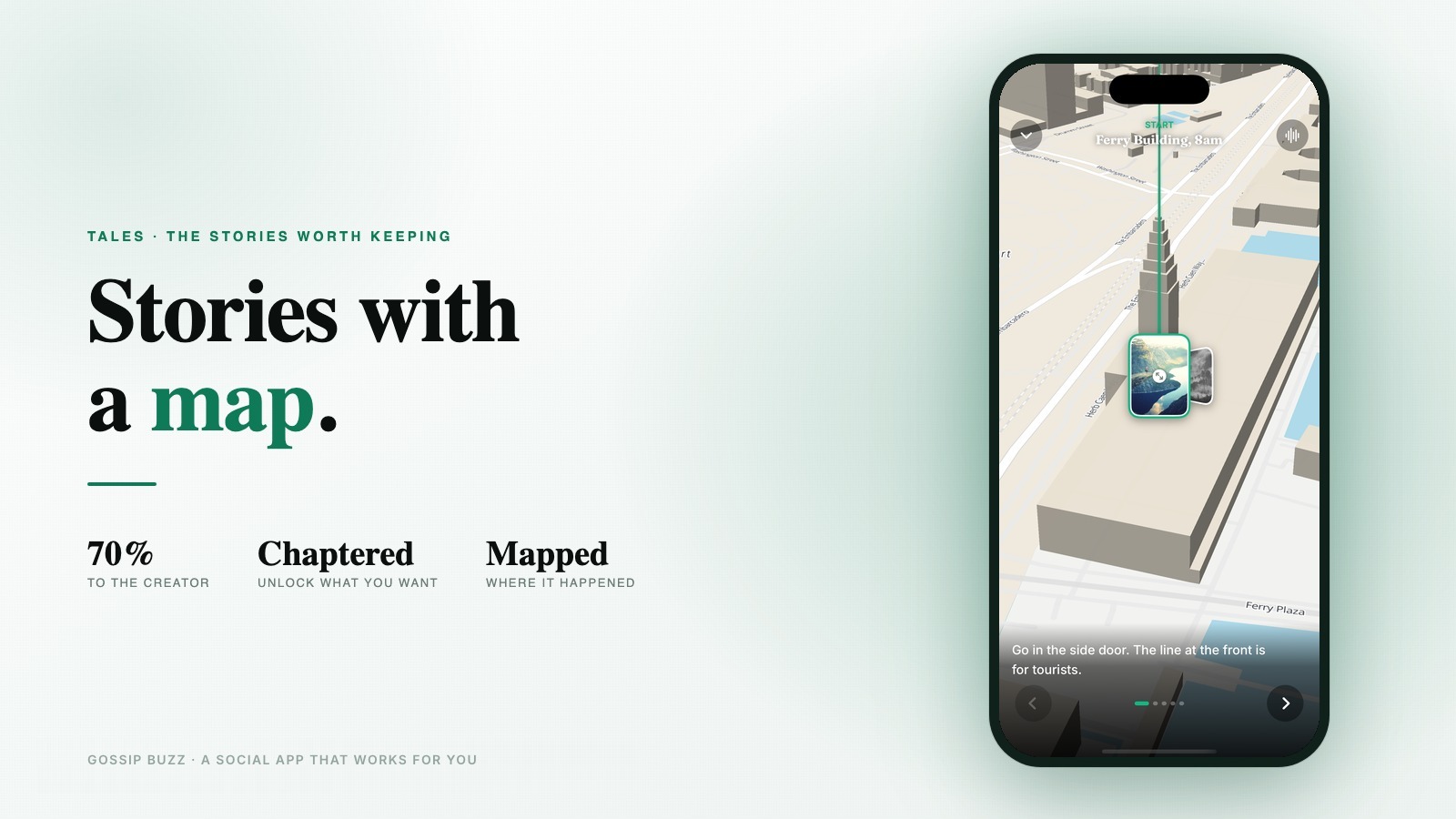
Tales are chaptered stories with a map — a road trip, a wedding weekend, a season of a small business — laid out chapter by chapter with the places they happened. Readers unlock the chapters they want; creators keep seventy percent. The opposite of a feed you scroll past and never find again.
All of which already exists. That is the unusual part.

Native iOS, native Android, a live backend — everything above is in production today, not a promise to build.
Your support funds what a finished product needs to reach people: the safety audit, moderation at volume, launch infrastructure, and runway to support the first real cohort of users.
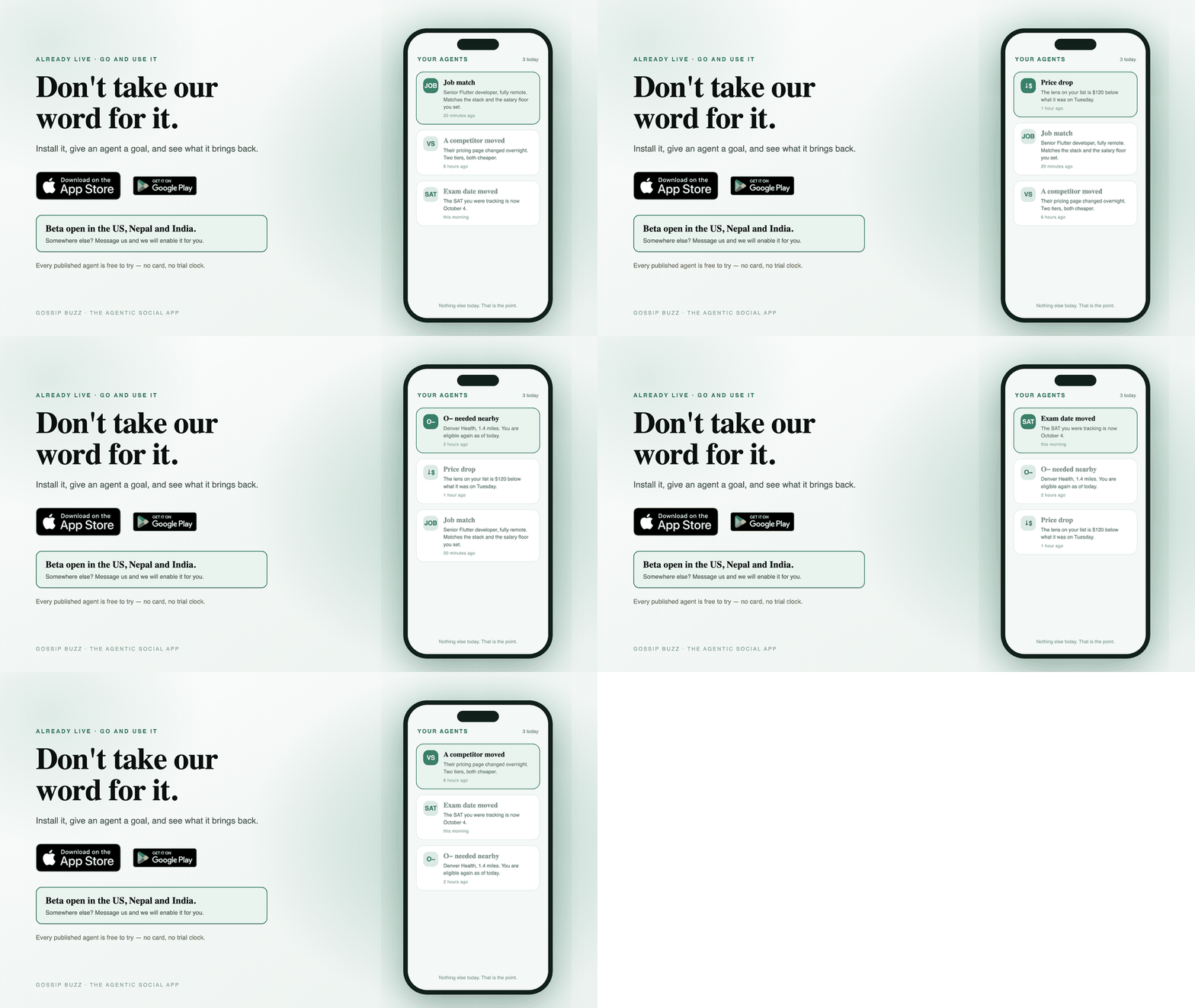
Don't take our word for any of it. The apps are live — install one, give an agent a goal, and see what it brings back. Every published agent is free to try.
The beta is open in the United States, Nepal and India. Somewhere else and want to try it before backing? Get in touch and we will enable it for you.
💵 $5,000 to start — and what comes after
The app is built and running. Our goal is $5,000 — the minimum to put v1 in front of the public safely. Kickstarter is all-or-nothing, so if we do not reach it nobody is charged. Everything past it goes to the work below, in this order. These are one-time costs with an end state, not ads and not salaries-forever, and each line says what exists today and what the money changes.
Launch infrastructure — first phasethe goal
The minimum to put v1 in front of the public safely: calls, media storage and servers sized past a beta. This is the goal. If we do not reach it nobody is charged and nothing changes hands.
Launch infrastructure, complete
TURN/SFU for calls, media storage and servers sized for a public launch rather than a beta. Running today on a footprint that will not survive week one.
Independent security & safety audit
The encryption and the on-device child-safety scanner reviewed by a third party. Built and working; never externally audited. This is the gap between "we believe it is safe" and "someone independent checked".
Child-safety moderation
A trained human team plus the review tooling. The automated layer ships today; a person has to be reachable the day something slips through it.
Store & legal compliance
Privacy, child-safety law and store requirements across the regions we launch in. Partly done — the remainder is legal review we cannot do ourselves.
More live sources for the agents
The agents run on 110 sources today. Rent listings, utility outages, local exam boards and government notices need licensed or built feeds, region by region.
Localization
Eleven South Asian languages, checked by people who speak them, not by a model.
Runway to public launch
A small team, full-time, through beta → v1. The whole job, funded.
Amounts are cumulative totals raised, not the cost of each line on its own.
🎁 Rewards — if you want one
Most people back this simply to see it exist — and your name goes on the donor wall. If you'd rather have something in return, these are the tiers.
⚠️ Risks & challenges
The usual risk — that the product never gets built — does not apply here; it is live on both stores today. The real ones are these. We depend on third-party sources, some of them free tiers that can rate-limit or disappear; we treat sources as configuration so one can be swapped without an app update, but losing them is a recurring cost. Agent quality is a moving target — an agent that reports something irrelevant is worse than one that says nothing, and tuning that is ongoing work. AI running costs scale with use, which bites hardest exactly when revenue is thinnest. App-store review governs our release cadence on both platforms. And we are a small team: support and moderation load grows faster than headcount, which is part of what this raise funds.
What won't change: no ads, no selling your data, and child-safety first.
❓ FAQ
Is the app really built?
Yes — it’s live on the App Store and Google Play today, with the backend in production. You’re funding the audit and launch hardening, not an idea.
Can I try it before backing?
Please do. The beta is open in the US, Nepal and India, and every published agent is free to try. If you’re elsewhere, get in touch and we’ll enable it for you.
What does “600 sources” actually mean?
A registry of published feeds and APIs the agents read from — news, jobs, government notices, prices, health, learning. Sources are configuration, so one can be added or swapped without shipping an app update.
Why subscriptions and not ads?
An ad model needs your attention to grow, which is the exact incentive that produced the feeds we’re reacting to. Subscriptions are why the app is allowed to be quiet.
When am I charged?
Once, securely via Stripe, right when you back us. We never see your card details.
Is my contribution tax-deductible?
No — we’re not a registered charity, so this is “back us” support, not a tax-deductible donation.
🧠 Use of AI
Agents call third-party language models for two narrow jobs: deciding whether something matches the goal you set, and condensing it to a couple of lines. Each item is shown with the source it came from and a link back to the original. We do not train models, and your private messages are end-to-end encrypted and unreadable by us, so they are never sent to one. Agent output is labelled as agent output everywhere it appears and is never presented as another person's post.
AI also runs in safety rather than content — uploads are scanned before they reach anyone, and posts are fingerprinted so coordinated near-duplicate campaigns can be clustered and reviewed. That is detection, not generation.
And most of what decides your experience is not a model at all — it is our own algorithm, written by us. What ranks in your feed is an explicit scoring formula over engagement, freshness, locality and who you follow, with a diversity rule so no single author can dominate. The country affinity that shapes it is learned from your own engagement over a rolling thirty days. Profile health, age-band filtering and the near-duplicate clustering are ours too.
We think that distinction matters. An algorithm we wrote can be read, explained and corrected when it is wrong. A model nobody can inspect should not be the thing deciding what a child sees.
© 2026 Gossip Buzz